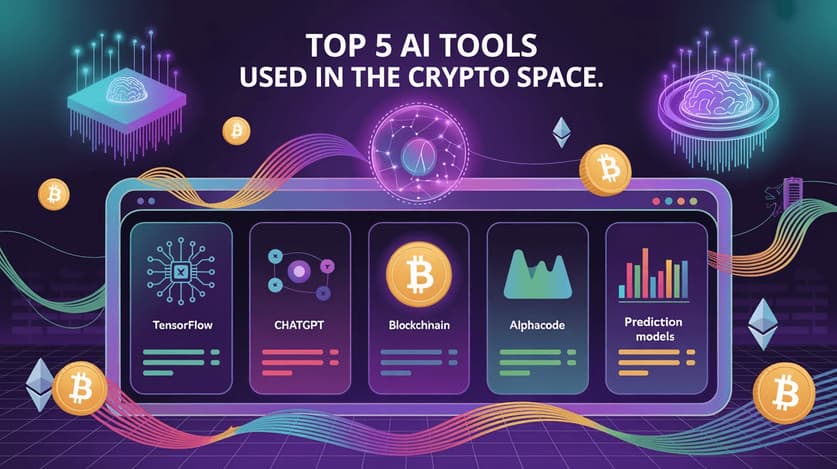
While skeptics continue to warn humanity about the global risks of widespread adoption of artificial intelligence, the AI market continues its exponential growth.
Forbes analytical research suggests that artificial intelligence is one of the fastest growing industries in the world, and its market capitalization growth rate will be at least 35% per year until the end of this decade. And this data is not based on hype or speculation. Breakthrough technologies in the fields of generative AI and natural language processing provide a solid basis for the fact that the contribution of artificial intelligence has all the real prerequisites for significant growth.
And the cryptocurrency market is far from an exception. Being one of the most high-tech sectors of the global economy, the blockchain and decentralized finance industry willingly absorbs and adapts all AI innovations to the existing realities.
Let’s understand in this article how artificial intelligence and cryptocurrencies are connected, what is the market potential of AI coins and what are the features of AI cryptocurrencies compared to traditional ones.
What are AI coins
AI cryptocurrencies are digital assets that utilize artificial intelligence in the broadest sense. They can be either cryptocurrencies of AI projects or coins that enable a wide variety of artificial intelligence capabilities to be applied to various blockchain ecosystems.
The comparison between AI and traditional cryptocurrencies goes in favor of digital assets with artificial intelligence on the following characteristics: the use of AI in cryptocurrencies increases their efficiency, security, scalability and usability.
The potential of AI in crypto
The confident development of AI in cryptocurrencies is due to the fact that the decentralized financial market operates on digital technologies, and artificial intelligence can significantly improve them. This primarily concerns the following areas:
- Improvement of algorithms and protocols. In particular, machine learning optimizes consensus processes and provides greater security for AI cryptocurrencies and blockchain networks through advanced encryption methods.
- Additional defense against cyber threats. AI technologies are able to detect and thereby prevent hacks and cyberattacks on cryptocurrency platforms, providing greater security.
Optimization of processes in mining. The potential of artificial intelligence can also improve the coin mining process by managing energy consumption and reducing costs. In particular, Iris Energy, a company specializing in net mining, is actively investing in generative artificial intelligence projects. - Development of decentralized applications. Artificial intelligence can be applied to create even more feature-rich and decentralized applications (DApps), pushing the boundaries of blockchain technology’s capabilities.
- Creating better cryptocurrencies. AI trends in cryptocurrencies help in the development of new coins with more advanced functionality and features.
The impact of AI on blockchain and cryptocurrencies is also seen in the optimization of many processes in trading:
- Modernization of trading algorithms. Automating trading through AI allows for in-depth research, thorough analytics based on huge data sets, and closing fast trades with a large number of variable criteria.
- Opportunities for more informed decisions by investors and traders.
- The high availability of the maximum number of technical indicators and historical data ensures price forecasting with minimal error (this applies to forecasts for AI coins as well as for any other cryptocurrency).
Prospects for the interaction between cryptocurrencies and artificial intelligence
AI and the future of cryptocurrencies are closely linked, and their convergence shows extensive prospects. Vitalik Buterin, co-founder and thought leader of Ethereum, in a recent article highlighted the main promising opportunities identified at the intersection of both technologies over the past years:
- The decentralized nature of blockchain can offset the centralization of AI through its ability to provide transparency, security, and information storage.
Artificial intelligence will seamlessly integrate into blockchain technology, including through the implementation of the latest powerful solutions for scalability of decentralized networks (like ZKP, FHE and MPC). With the simultaneous emergence of large language models, these solutions will help manifest deep integration capabilities to their fullest potential.
The decentralized prediction segment is stagnating, and the symbiosis of AI and DeFi will provide an opportunity for the success of the prediction sector, widely used in trading. Low-cost AI-based tools will provide an opportunity to strengthen it significantly.
In conclusion
Analyzing the risks and benefits of AI tokens, one should be aware that artificial intelligence is a trend that humanity will not be able to avoid. The fusion of two advanced technologies demonstrates high efficiency and becomes the subject of increased attention of investors. And given the high mobilization of regulators around the world in an effort to “streamline” the rally in AI developments, we can expect that the symbiosis of blockchain and artificial intelligence will bring only positive changes to global financial systems and the lives of ordinary users.