In today’s fast-paced financial markets, high volatility presents both opportunities and significant risks for traders. Artificial intelligence (AI) has become a powerful ally in helping traders navigate such turbulent conditions by providing real-time insights and data-driven decision support. AI-powered algorithms can analyze vast amounts of market data—such as price movements, economic indicators, and social sentiment—faster and more accurately than any human. This enables traders to identify patterns and potential price shifts before they materialize, giving them a competitive edge during volatile periods when markets can swing unpredictably within minutes.
Moreover, AI enhances risk management by dynamically adjusting trading strategies based on market behavior. For instance, platforms like the Exness app integrate AI-driven tools that help users monitor multiple assets, set smart alerts, and automate trades with precision. These features are particularly useful in volatile environments where manual trading could lead to delayed responses and emotional decision-making. By leveraging AI, traders can maintain discipline, respond swiftly to market changes, and reduce the likelihood of losses caused by irrational reactions. In essence, AI acts as both a guide and a guardrail, helping traders stay on course when markets become chaotic.
Overview of AI
Artificial Intelligence (AI) refers to the simulation of human intelligence processes by machines, particularly computer systems. These processes include learning (the acquisition of information and rules for using it), reasoning (using rules to reach approximate or definite conclusions), and self-correction. AI encompasses a broad range of subfields, including machine learning (ML), natural language processing (NLP), computer vision, robotics, and expert systems.
Core Capabilities of AI
At its core, AI enables machines to perform tasks that typically require human cognition—such as recognizing speech, interpreting images, making decisions, and translating languages. AI systems can be narrow (specialized for a specific task, like spam filtering or facial recognition) or general (capable of understanding and learning any intellectual task that a human can do, though this level remains theoretical).
Practical Applications and Impact
In practice, AI is already embedded in daily technologies, from virtual assistants and recommendation engines to autonomous vehicles and financial trading algorithms. As AI continues to evolve, it is transforming industries by enhancing efficiency, enabling automation, and uncovering insights from massive datasets that would be otherwise impossible for humans to analyze alone.
Key Features of AI
Learning from Data
- AI systems can learn patterns, relationships, and rules from structured and unstructured data.
- Includes supervised, unsupervised, and reinforcement learning.
Automation
- Performs repetitive or complex tasks without human intervention.
- Common in algorithmic trading, chatbots, fraud detection, etc.
Adaptability
- AI can adjust to new data or changing environments.
- Especially valuable in dynamic fields like finance, e-commerce, and healthcare.
Problem-Solving Ability
- Capable of solving complex problems using logical reasoning and heuristics.
- Used in predictive modeling, optimization, and decision support.
Natural Language Processing (NLP)
- Understands, interprets, and generates human language.
- Powers voice assistants, chatbots, and real-time sentiment analysis tools.
Perception
- Interprets inputs from the physical world (vision, audio, sensors).
- Enables computer vision, facial recognition, and autonomous systems.
Decision-Making
- Evaluates data to make or suggest decisions based on probabilities or rules.
- Used in trading, medical diagnosis, logistics, etc.
Pattern Recognition
- Detects trends, anomalies, or behaviors within large datasets.
- Supports fraud detection, image recognition, and market forecasting.
Self-Correction
- Continuously improves its performance by learning from mistakes.
- Critical for refining algorithms and reducing prediction errors over time.
Scalability
- Easily deployable across various sectors and use cases with minimal manual reprogramming.
- Allows rapid expansion and adoption of AI solutions.
Understanding Market Volatility
Market volatility refers to the degree of variation in the price of financial instruments—such as stocks, currencies, or commodities—over a specific period. High volatility means prices fluctuate rapidly and unpredictably, while low volatility indicates more stable and consistent price movements. Volatility is a key metric for traders and investors because it signals both the risk and opportunity inherent in market activity. It is commonly measured using statistical metrics like standard deviation or tools such as the Volatility Index (VIX), often referred to as the “fear gauge” of the market.
Volatility can be driven by a range of factors, including macroeconomic announcements (like interest rate decisions or inflation data), political instability, corporate earnings reports, and unexpected global events (e.g., pandemics or natural disasters). There are two primary types of volatility: historical volatility, which is based on past price movements, and implied volatility, which reflects market expectations of future volatility and is often derived from options pricing. While high volatility can increase risk, it also creates more trading opportunities, especially for short-term traders who can capitalize on rapid price swings. Understanding the causes, types, and implications of market volatility is essential for crafting effective trading strategies and managing financial risk.
Role of AI in Mitigating Volatility-Related Challenges
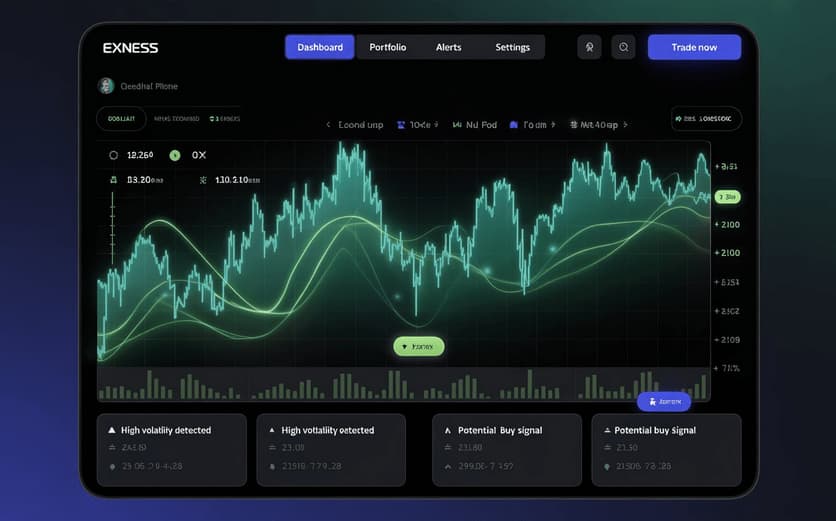
High market volatility creates major challenges for traders, including unpredictable price swings, emotional decision-making, and the necessity for rapid reactions. Artificial Intelligence (AI) helps mitigate these issues by providing powerful tools for real-time data analysis, automated decisions, and advanced risk management. AI processes vast datasets from sources like live market feeds, economic indicators, social media sentiment, and news, delivering insights faster than humans. This enables traders to anticipate sudden market changes and respond strategically.
Key ways AI mitigates volatility-related challenges include:
- Executing thousands of trades in milliseconds via AI-driven algorithmic and high-frequency trading bots.
- Identifying micro-opportunities in price movements invisible to manual traders.
- Continuously adapting trading strategies through machine learning based on new market data.
- Enhancing risk management tools such as Value at Risk (VaR) and stress testing with dynamic, real-time inputs.
- Detecting anomalies and unusual patterns indicating systemic risks or market manipulation.
- Integrating AI-informed analytics and automation in trading platforms like the Exness app to improve control and reduce losses.
- Helping traders exploit market volatility for potential gains while minimizing downside risks.
Future AI Methods in Trading
As financial markets continue to evolve, the next wave of AI technologies is poised to revolutionize trading even further. One of the most promising frontiers is reinforcement learning (RL)—a branch of AI where algorithms learn by interacting with the market environment, receiving feedback in the form of rewards or penalties. Unlike traditional machine learning models that rely on static datasets, RL-based systems can adapt dynamically to changing market conditions, making them particularly effective in highly volatile or uncertain environments. These agents can continuously optimize trading strategies, balance risk-reward trade-offs in real time, and even simulate “what-if” scenarios to prepare for rare market events.
| AI Method | Description | Benefits / Use Cases |
| Reinforcement Learning (RL) | Learns through trial and error. | Adapts dynamically to changing market conditions; builds self-improving trading agents. |
| Explainable AI (XAI) | Provides transparency in AI decision-making. | Helps traders and regulators understand model behavior; enhances trust and accountability. |
| Multi-Agent Systems | Simulates complex market dynamics with interacting AI agents. | Models competitive and cooperative strategies; useful for stress testing and scenario analysis. |
| Neuro-Symbolic AI | Combines neural networks with symbolic reasoning. | Supports logical and interpretable trading strategies; enhances strategic decision-making under uncertainty. |
| Federated Learning | Trains AI models across decentralized data sources. | Maintains data privacy; enables collaboration across institutions without data sharing. |
| Edge AI for Real-Time Execution | Executes AI algorithms closer to data sources (e.g., exchange servers). | Reduces latency in high-frequency trading; improves speed and precision in volatile markets. |
| AI-Powered Behavioral Finance Models | Analyzes trader psychology and market sentiment. | Detects patterns like herding or overreaction; helps mitigate emotionally driven market decisions. |
| Quantum-Inspired AI Algorithms | Uses quantum principles for advanced optimization. | Potentially outperforms classical AI in portfolio selection; still early but rapidly advancing. |
Conclusion
In an era where financial markets are increasingly fast-moving and unpredictable, artificial intelligence has emerged as an indispensable tool for traders navigating high volatility. By harnessing AI’s capabilities—such as real-time data analysis, predictive modeling, and automated decision-making—traders can respond to rapid market changes with greater speed, precision, and confidence. AI not only enhances the ability to identify trading opportunities in volatile conditions but also strengthens risk management and reduces the emotional biases that often lead to poor decisions.
As AI technologies continue to evolve—introducing innovations like reinforcement learning, explainable models, and advanced behavioral analysis—the edge they provide to traders will only grow sharper. Platforms that integrate AI, exemplify how accessible and powerful these tools have become. Ultimately, the fusion of human intuition with machine intelligence represents the future of smart, adaptive trading in a volatile world.